Focus On:
4 min read
Tune-In Tuesday – #10 Focus On: Immersive experiences — when do they actually work?
Immersive experiences — when do they actually work?
“Immersive” has become one of the most heavily used words across digital experiences, events and brand activations over the past few years. Almost every installation, environment or technology setup now seems to position itself as immersive in some way.
And to be fair, some of these experiences are genuinely impressive.
But increasingly, there’s a noticeable difference between experiences that simply look immersive and experiences that actually create meaningful engagement.
Because immersion on its own isn’t automatically valuable anymore.
The problem with immersion for the sake of it
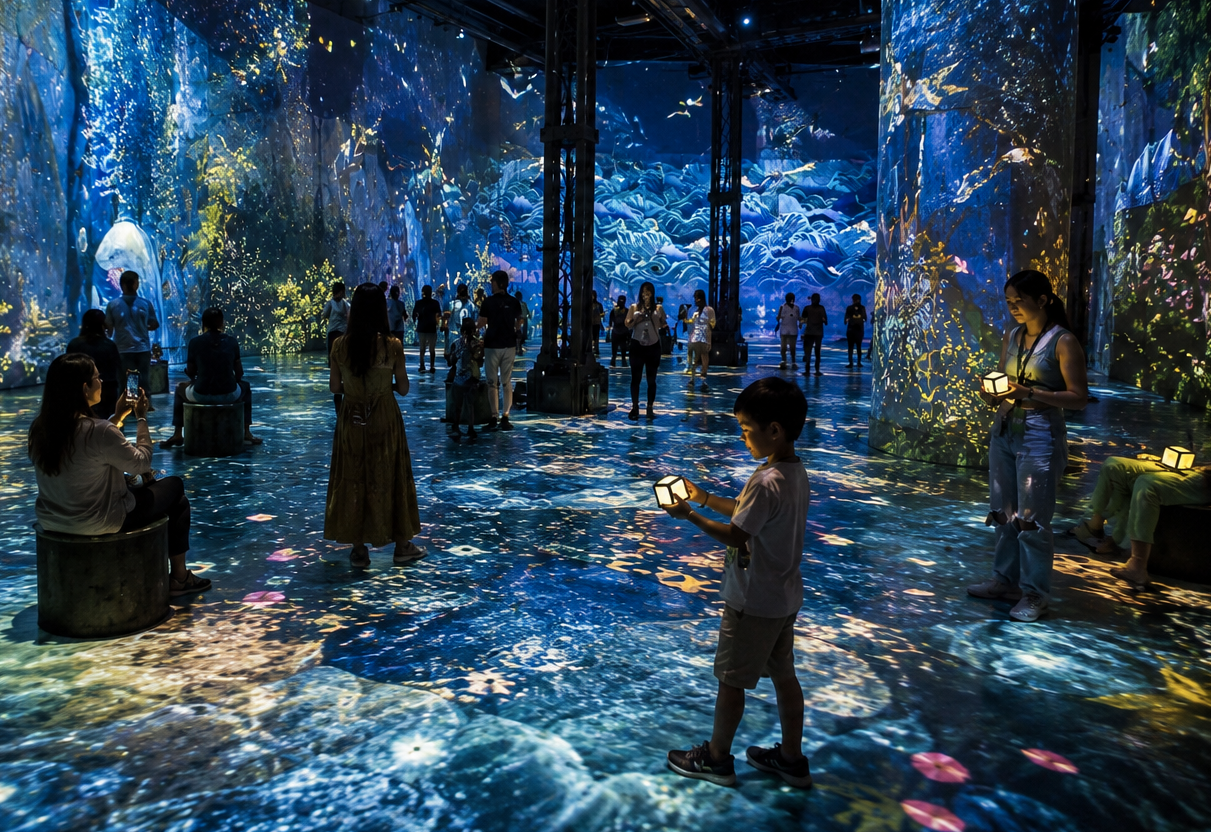
A lot of immersive experiences create a strong first impression very quickly. Large-scale visuals, spatial audio, projection environments and reactive technology can generate an immediate “wow moment”.
The challenge is what happens afterwards.
In many cases, the immersion itself becomes the entire experience rather than supporting a wider purpose or interaction. Once the novelty fades, engagement often drops because audiences aren’t being guided towards anything meaningful beyond the spectacle itself.
That’s where immersive experiences can start to feel surprisingly shallow despite the amount of technology involved.
Interestingly, the strongest immersive projects are rarely defined by how much technology they use. They’re usually defined by how the audience feels inside the experience.
Questions like:
- Do people understand it quickly?
- Does the environment support the story?
- Does it encourage participation naturally?
- Does it help people remember something more clearly?
- Does it create emotional connection?
That’s where immersion starts becoming genuinely effective.
Where immersive experiences work best
We’re seeing immersive technology perform particularly well in environments where it helps simplify understanding, strengthen storytelling or allow audiences to experience something they otherwise couldn’t.
For example:
- Storytelling
- Guided exploration
- Simulation
- Behavioural learning
- Spatial understanding
- Emotional engagement
- Collaborative interaction
In these situations, immersion enhances the outcome rather than distracting from it.
That’s especially true across healthcare, training, exhibitions, events and learning environments where experiences often need to communicate something complex in a way that feels memorable and intuitive.
The shift towards more intentional immersive design
One of the biggest changes happening now is that businesses are becoming much more commercially focused around immersive technology. There’s far less appetite for expensive installations that generate attention but little measurable engagement or long-term value.
Instead, the focus is shifting towards things like:
- Meaningful interaction
- Audience flow
- Accessibility
- Content clarity
- Emotional connection
- Lower-friction experiences
- Reusable systems
Interestingly, many of the strongest immersive experiences actually feel quite simple from the audience perspective. The technology fades into the background because the interaction itself feels natural and effortless.
That’s usually a sign the experience has been designed properly.
Audiences expect more now
Another important shift is that audiences themselves have changed. People are now far more familiar with immersive technology than they were a few years ago. Projection mapping, interactive environments and digital installations no longer feel new on their own.
The novelty factor simply isn’t enough anymore.
Audiences increasingly expect immersive experiences to add genuine value rather than simply surrounding them with technology.
At Lucden, a lot of our immersive work starts by understanding the audience journey before discussing platforms, hardware or visual systems. The goal is never simply to make something “immersive”.
It’s to make something clearer, more memorable, easier to understand and ultimately more effective for the audience and the business behind it.
Because immersive technology only becomes valuable when the experience itself has purpose.