Behind the build
4 min read
Behind the build: The importance of integration in event experiences
Why disconnected systems create fragmented event journeys
One of the biggest challenges in event technology is that many platforms were never originally designed to work together.
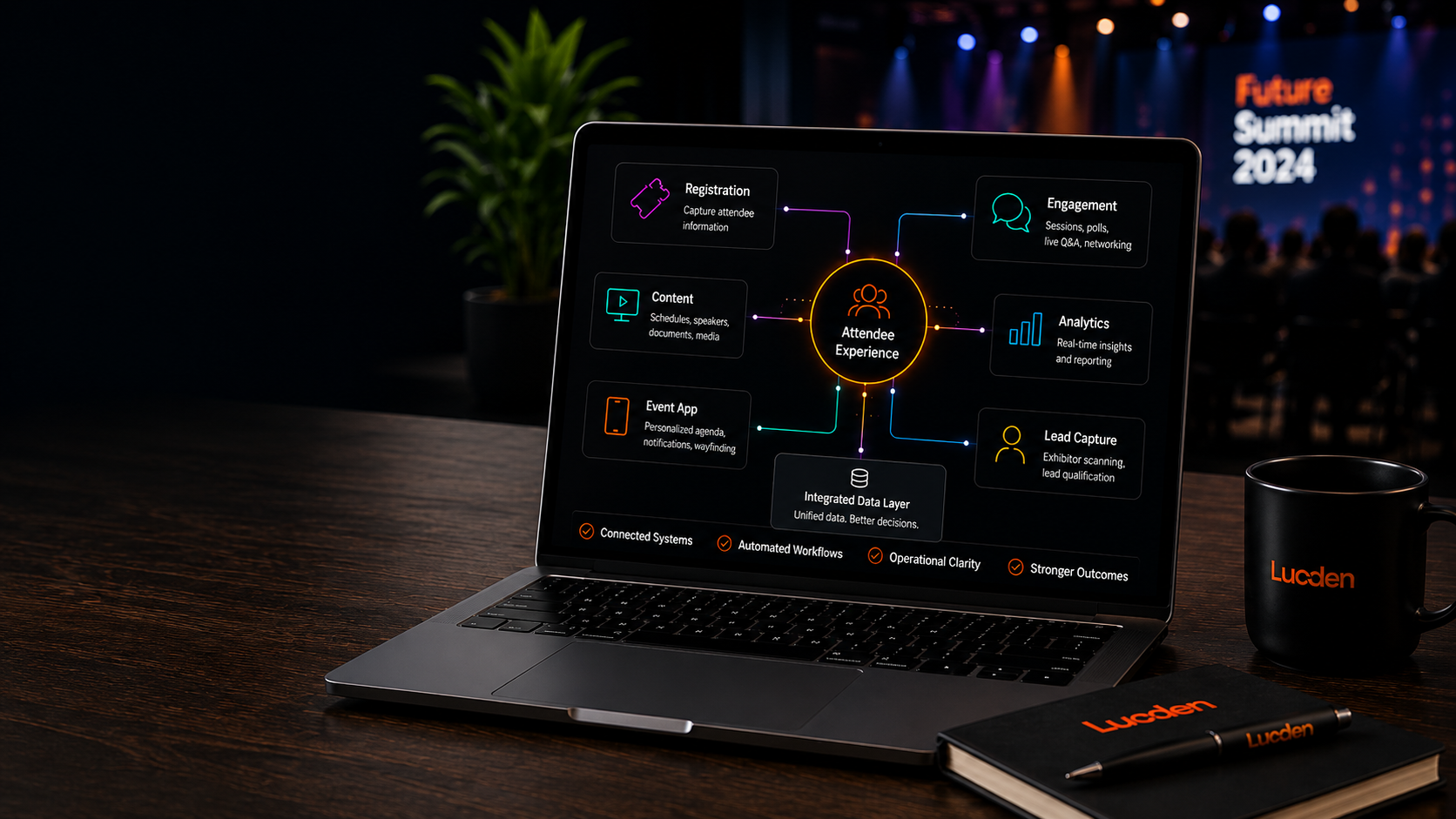
Registration systems operate independently. Engagement platforms sit separately. Analytics tools collect data in isolation while content management systems, lead capture tools and reporting dashboards often exist across completely different environments.
Individually, each platform may function well.
Collectively, they often create fragmented experiences for both attendees and internal event teams.
That fragmentation usually becomes visible very quickly during live events.
When operational complexity builds behind the scenes
We regularly work on projects where teams are manually transferring data between systems, attendees are being pushed through disconnected journeys and valuable event insights are spread across multiple platforms with very little visibility between them.
From the outside, the technology stack may appear comprehensive.
Behind the scenes, however, the experience can become operationally heavy and difficult to manage efficiently.
We recently worked through an event technology project where the biggest issue wasn’t a lack of capability — it was a lack of connection between the systems already in place.
The registration platform contained attendee information, engagement data lived elsewhere and reporting was being managed independently across multiple environments.
Several manual processes existed purely to bridge gaps between systems that weren’t communicating effectively with one another.
Why integration strategy matters early
That kind of fragmentation creates friction surprisingly quickly.
Attendees experience inconsistent journeys, teams lose visibility and reporting becomes harder to trust across the event lifecycle.
Importantly, many of these problems aren’t solved simply by introducing more technology.
In many cases, the opposite is true.
The more disconnected systems added into an ecosystem, the more complexity often gets introduced unless the integration strategy is considered properly from the beginning.
That’s why a large part of our process focuses on mapping how systems connect before new experiences are designed or deployed.
Designing event ecosystems that work together
We look closely at:
- How information moves across the event journey
- Where operational friction exists
- Which systems genuinely need to communicate
- Where duplication occurs
- How data visibility can improve
- Where manual intervention is slowing processes down
- How attendees experience the ecosystem as a whole
That systems-thinking approach is incredibly important within live event environments because attendees rarely care which platform they’re interacting with underneath the experience.
They simply expect the journey to feel seamless.
The strongest event ecosystems usually feel connected and consistent even when multiple technologies are operating behind the scenes.
Why connected systems create better event experiences
In this particular project, much of the work focused on simplifying the flow of information between systems and reducing unnecessary operational complexity.
Certain processes became automated, visibility improved across teams and the attendee journey itself became significantly smoother because the underlying platforms were working together more effectively.
Importantly, the project reinforced something we see repeatedly across event experience design:
Good event technology is rarely about how many systems exist.
More often, it’s about how intelligently those systems connect together.
That’s usually where operational clarity begins.
Summary
Many event challenges are caused not by missing technology, but by disconnected systems creating operational friction behind the scenes.
Improving integrations, reducing duplication and creating better visibility across platforms can significantly improve both attendee experiences and internal event operations without necessarily introducing additional technology.
Working on something similar?
Feel free to drop the Lucden team a message on hello@lucden.com or call 0207 101 3268. Always happy to chat ideas through.