Behind the build
4 min read
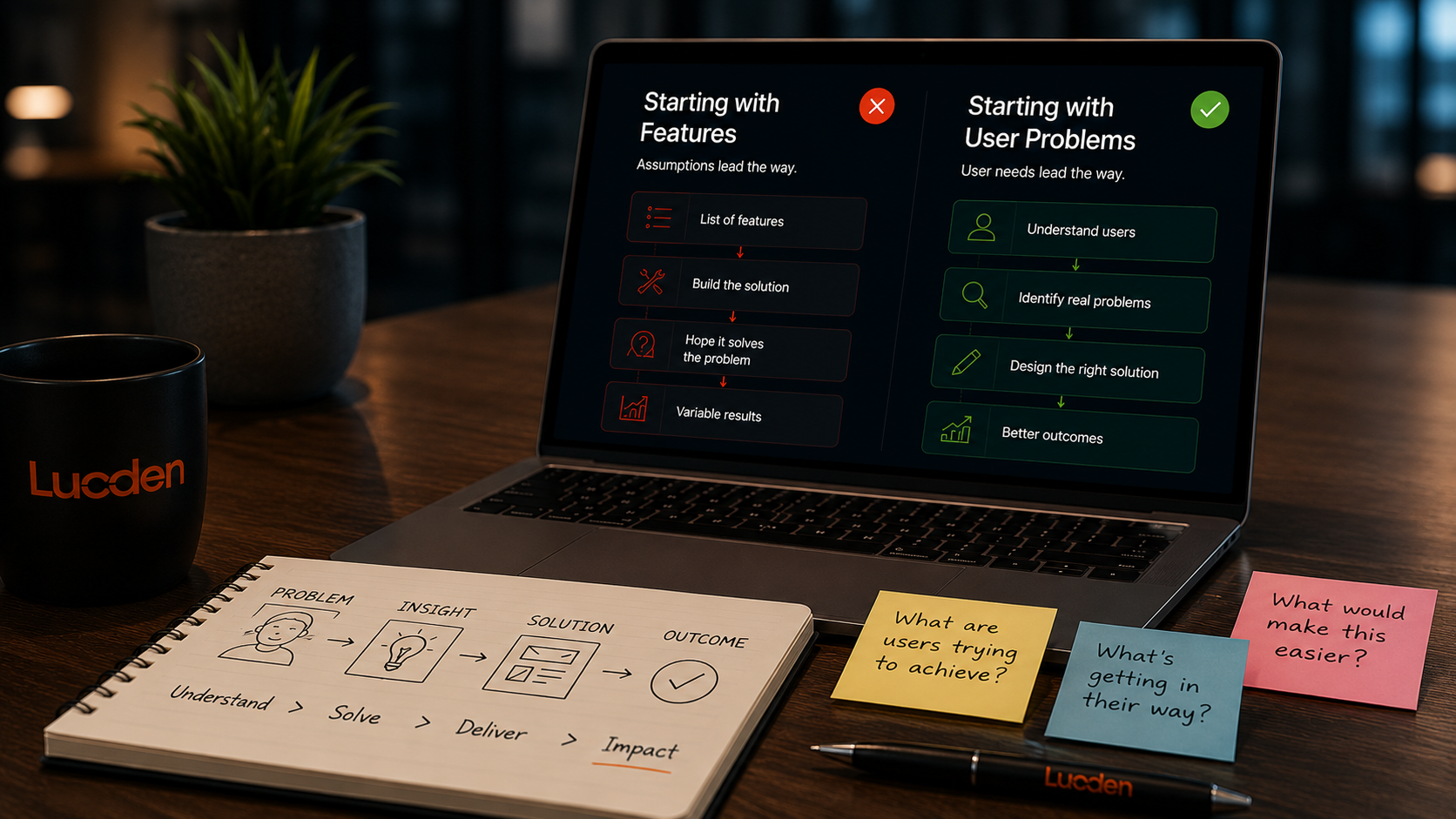
Behind the build: Starting with user problems first
Why feature-first thinking often creates weaker products
One of the most common mistakes in digital product development is starting with features before understanding the actual problem.
Teams often begin projects discussing dashboards, integrations, functionality and interface ideas almost immediately. Feature lists grow quickly, requirements become increasingly detailed and the product starts taking shape around assumptions rather than genuine user behaviour.
But strong digital products rarely begin with features.
They usually begin with frustration.
We regularly work on projects where the biggest improvements come not from adding more capability, but from properly understanding what users are struggling with in the first place.
Understanding behaviour before building solutions
We recently worked through a digital product project where the initial conversations were heavily focused around functionality.
Stakeholders had already identified multiple features they believed the platform required and the roadmap was beginning to form around those assumptions.
On paper, the direction appeared logical.
But once we spent time analysing how users actually interacted with the wider process surrounding the product, a very different picture started emerging.
Many of the proposed features were solving secondary issues rather than the core frustrations users were experiencing day to day.
Certain workflows were unnecessarily complicated, some interactions created hesitation and several assumptions about user behaviour simply didn’t reflect how people naturally moved through the experience in practice.
Why clarity matters more than feature count
That’s an incredibly common pattern within digital products.
Teams naturally focus on what they can build before fully understanding what users actually need.
But functionality alone rarely creates a strong product experience.
Clarity does. Simplicity does. Relevance does.
Our approach focused heavily on understanding behaviour before discussing solutions.
We looked closely at:
- Where users experienced friction
- What slowed tasks down
- Which behaviours repeated consistently
- Where confusion or hesitation occurred
- What users were trying to achieve emotionally and functionally
- Which problems genuinely mattered most
That process often changes project direction dramatically.
Creating more meaningful functionality
In this particular project, several planned features became unnecessary once the underlying user behaviour was understood more clearly.
Other areas of the experience became far more important than initially expected because they directly affected usability, confidence and task completion.
Importantly, the goal wasn’t simply to reduce functionality.
It was to create more meaningful functionality.
That distinction matters enormously within product design.
The strongest digital products usually feel focused because they solve specific problems exceptionally well rather than attempting to do everything simultaneously.
Good product experiences reduce effort.
Designing products around real user behaviour
Users should feel like the platform understands what they’re trying to achieve and helps them move through the experience naturally without unnecessary complexity or distraction.
This becomes especially important as products scale.
Adding features without understanding user behaviour often creates heavier interfaces, fragmented workflows and increased cognitive load over time. Starting with genuine user problems creates a much stronger foundation for long-term product growth because the experience evolves around real usage patterns rather than assumptions.
Following the discovery and restructuring process, the product direction became significantly clearer and more focused. The experience simplified considerably, priorities shifted towards higher-value interactions and the overall platform became far more aligned with how users actually behaved rather than how teams initially imagined they behaved.
It reinforced something we see repeatedly across digital product design:
The best digital products rarely start with features.
They start with understanding people properly.
That’s usually where stronger products begin.
Summary
Strong digital products are rarely created by simply adding more features. More often, successful product experiences come from understanding genuine user frustrations, simplifying workflows and designing around real behaviour rather than assumptions.
Starting with user problems first can dramatically improve product clarity, usability and long-term scalability.
Working on something similar?
Feel free to drop the Lucden team a message on hello@lucden.com or call 0207 101 3268. Always happy to chat ideas through.