Behind the build
4 min read
Behind the build: Simplifying navigation at events
Why navigation has such a big impact on event experiences
One of the most underestimated parts of event experience design is navigation.
When wayfinding works well, people barely notice it.
Attendees move naturally through the environment, find what they need quickly and progress confidently between spaces without hesitation or confusion. But when navigation is unclear, even well-designed events can begin feeling stressful, fragmented and difficult to navigate.
That’s where digital wayfinding becomes incredibly important.
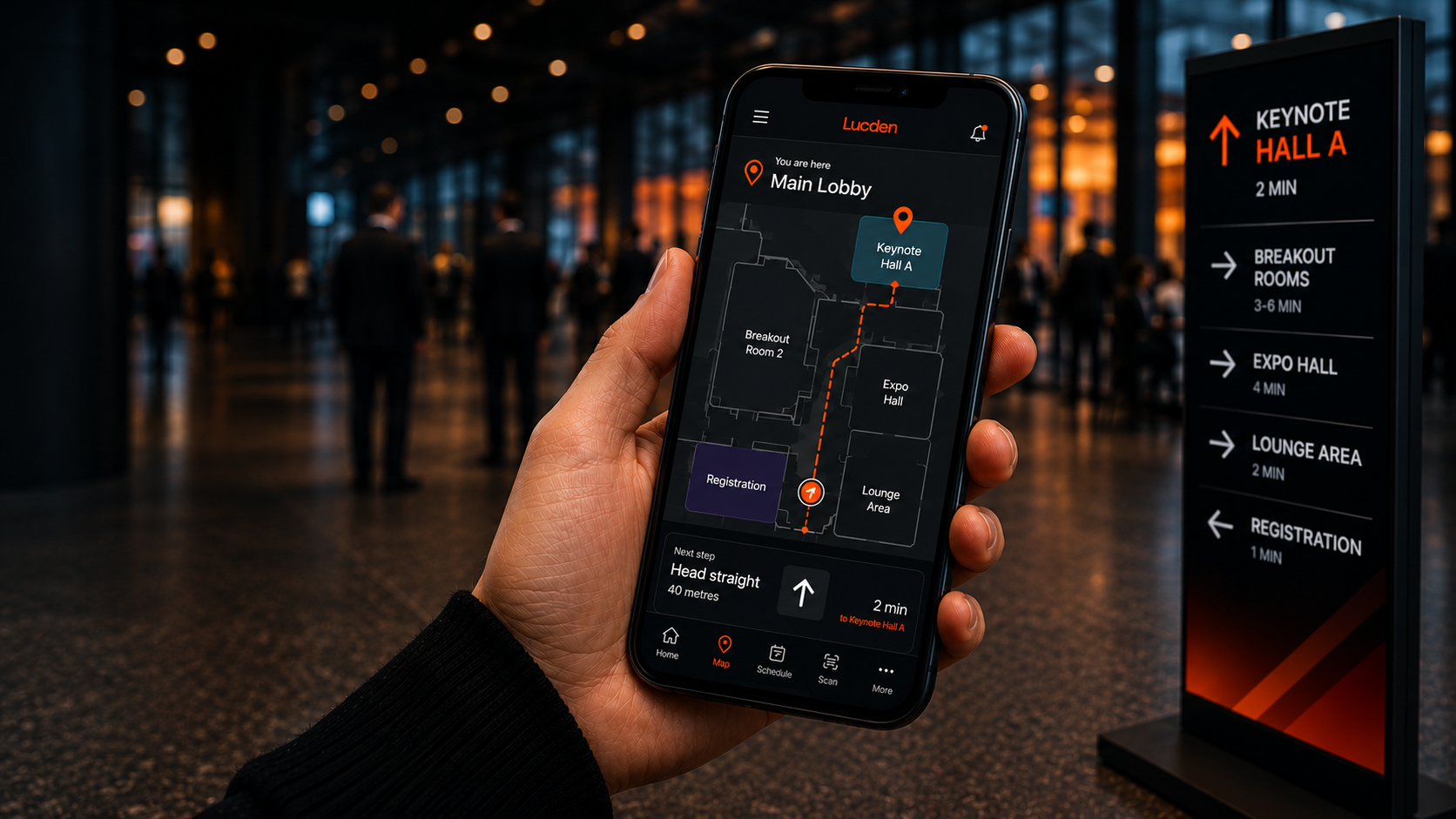
We regularly work on event experiences where the biggest challenge isn’t necessarily content or technology — it’s helping people understand where they are, where they need to go next and how to move through busy physical environments efficiently.
When more information creates more confusion
That sounds simple in theory.
In practice, it’s surprisingly easy to overcomplicate.
We recently worked through an event experience where attendees were struggling with navigation across multiple spaces, sessions and activation areas.
The original digital wayfinding system contained extensive information, layered menu structures and large amounts of content designed to support attendees throughout the venue.
Technically, everything users needed was available.
But operationally, people were still getting lost, hesitating at decision points and relying heavily on staff for guidance.
That’s a common issue within digital wayfinding.
More information does not automatically create more clarity.
Designing navigation around real attendee behaviour
In busy environments, people rarely stop to carefully study interfaces or interpret detailed navigation systems.
They’re moving quickly, multitasking, networking, attending sessions and often operating under time pressure.
In those moments, navigation needs to feel immediate.
Users should understand what to do almost instinctively.
Our approach focused heavily on simplifying the guidance experience and reducing the cognitive effort required to move through the environment confidently.
We looked closely at:
- Where users became uncertain
- How quickly navigation choices could be understood
- Where visual hierarchy could improve
- How contextual guidance could reduce hesitation
- Which information genuinely mattered in the moment
- How movement through the venue naturally behaved
Why clarity improves attendee flow
Large sections of the interface were simplified or restructured. Navigation pathways became shorter, key destinations became more visible and contextual prompts were introduced to guide attendees more naturally throughout the experience.
Importantly, the objective wasn’t simply to provide more directions.
It was to reduce uncertainty.
That distinction matters enormously within wayfinding design.
The strongest navigation systems rarely overwhelm users with options. More often, they create confidence through simplicity, clarity and timing.
Users should feel guided rather than instructed.
Good digital wayfinding quietly supports movement without demanding unnecessary attention.
Creating event journeys that feel effortless
This becomes especially important within live event environments where stress, noise, crowd movement and limited attention can all amplify even small moments of confusion.
Following the refinement process, attendee movement became significantly smoother across the venue. Users were able to navigate more confidently, hesitation reduced and operational pressure on event staff decreased because the guidance system itself became easier to trust and follow.
It reinforced something we see repeatedly across event experience design:
Wayfinding is rarely about adding more information.
More often, it’s about helping people feel confident enough to keep moving.
That’s usually where better event journeys begin.
Summary
Successful event navigation is rarely about providing more maps, menus or information layers. More often, strong wayfinding experiences are built around clarity, confidence and helping attendees move naturally through busy environments without hesitation.
Simplifying navigation pathways, improving contextual guidance and reducing cognitive effort can significantly improve attendee flow and overall event experience quality.
Working on something similar?
Feel free to drop the Lucden team a message on hello@lucden.com or call 0207 101 3268. Always happy to chat ideas through.