Behind the build
4 min read
Behind the build: Practical AI integration rather than novelty
Why AI doesn’t automatically improve digital experiences
AI is rapidly becoming part of almost every digital conversation.
New tools appear daily, features are being relabelled as “AI-powered” across entire industries and many digital experiences are now under pressure to incorporate artificial intelligence regardless of whether it genuinely improves the outcome.
That’s created an interesting challenge within digital projects.
Because while AI can absolutely create meaningful value, not every use case benefits from it.
We regularly work on projects where AI is initially positioned as a major feature within the experience. Sometimes it’s suggested as part of engagement, automation, personalisation or content generation.
On paper, many of these ideas sound impressive.
But one of the first questions we usually ask is simple:
Does AI genuinely improve the experience — or is it simply being added because the technology is visible right now?
When AI introduces more friction than value
We recently worked through a project where AI was originally expected to play a much larger role across the platform experience.
The initial concept contained several AI-driven interactions designed to increase engagement and automate parts of the workflow.
Technically, many of the ideas were possible.
But once we mapped the user journey properly, it became clear that some of the proposed AI functionality introduced additional complexity rather than reducing it.
Certain interactions slowed the experience down, others created unnecessary ambiguity and some features simply didn’t improve the user outcome enough to justify the additional friction being introduced.
That’s one of the biggest misconceptions surrounding AI integration.
More AI does not automatically create a better experience.
Designing AI around practical value
In many cases, users care far less about the technology itself than they do about whether the interaction feels faster, clearer and easier to use.
That’s where we focus most heavily.
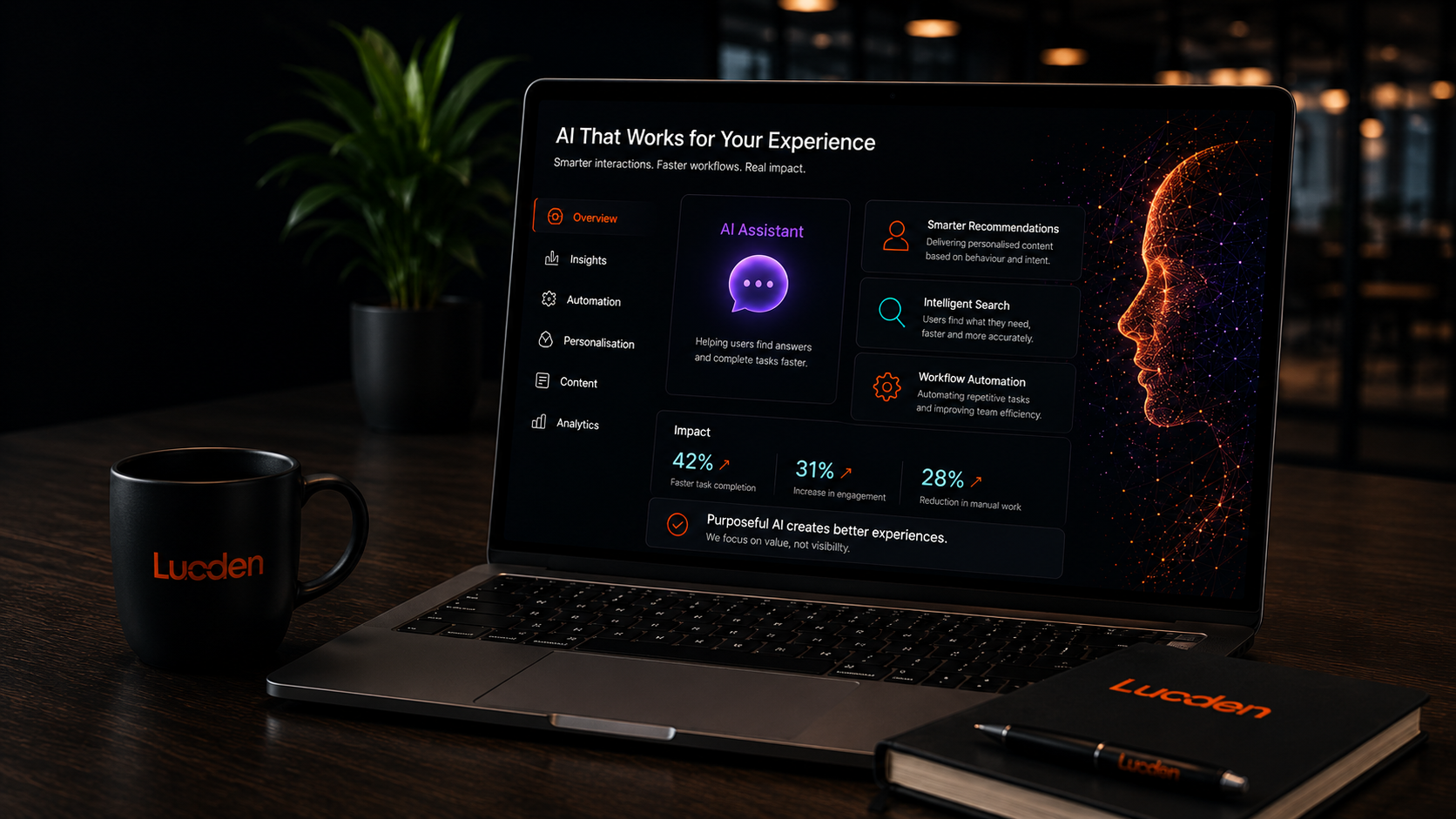
Our approach to AI integration is centred around practical value rather than novelty. We look closely at where AI can genuinely reduce friction, improve workflows or create more useful experiences without making the technology itself become the focus of the journey.
Sometimes that means:
- Simplifying repetitive processes
- Accelerating content workflows
- Improving search and discovery
- Creating more relevant personalisation
- Reducing operational overhead
- Surfacing information more intelligently
- Improving accessibility to complex systems
The strongest AI experiences usually support the interaction quietly in the background.
Why the best AI often feels invisible
Users shouldn’t need to stop and think about the fact that AI exists underneath the experience.
Ideally, the journey simply feels smoother, faster and more useful because the technology is working naturally behind the scenes.
That restraint is becoming increasingly important.
There’s currently a tendency within digital products to showcase AI visibly at every opportunity. But highly visible AI isn’t always good UX. In many cases, the most valuable implementation is the one users barely notice because it removes friction so naturally within the experience itself.
Importantly, the goal isn’t to reduce innovation.
It’s to ensure the technology is genuinely improving the experience.
Creating AI experiences that solve real problems
Following the refinement process in this particular project, the AI functionality became significantly more focused, purposeful and operationally valuable.
Several unnecessary concepts were removed, workflows became cleaner and the technology started supporting the experience rather than competing with it.
It reinforced something we see repeatedly across digital experience design:
AI becomes most valuable when it solves real problems quietly and effectively.
That’s usually where meaningful digital innovation begins.
Summary
Successful AI integration is rarely about adding artificial intelligence simply because the technology is trending. More often, the strongest AI experiences are the ones that reduce friction, improve workflows and quietly support users without making the technology itself become the focus.
Practical value, usability and clarity will usually create far more impact than novelty alone.
Working on something similar?
Feel free to drop the Lucden team a message on hello@lucden.com or call 0207 101 3268. Always happy to chat ideas through.