Behind the build
4 min read
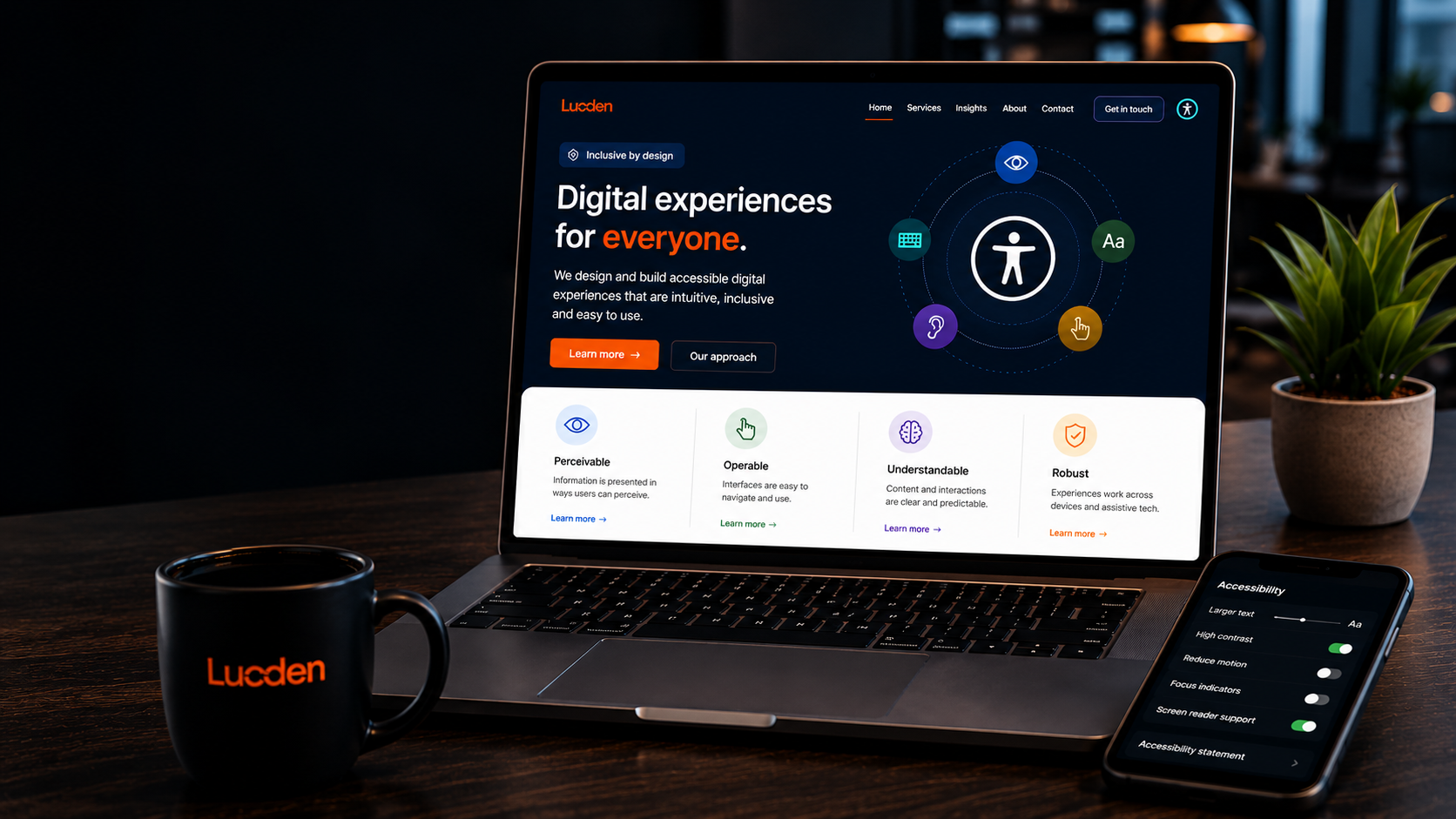
Behind the build: Designing digital experiences for accessibility
Why accessibility is more than compliance
Accessibility is often misunderstood within digital projects.
Many people still view it as a separate compliance requirement or a final checklist added towards the end of delivery. But in reality, accessibility is much broader than that.
Good accessibility is fundamentally good user experience design.
We regularly work on projects where improving accessibility also improves usability, clarity and engagement for almost every user interacting with the experience — not just users with specific accessibility requirements.
That’s an incredibly important distinction.
When accessibility improvements strengthen the entire experience
We recently worked through a digital platform project where accessibility initially entered the conversation as a technical consideration later in the delivery process.
The assumption was that accessibility improvements would mainly involve adjustments for compliance purposes.
But once the user experience was reviewed more holistically, it became clear that many of the accessibility improvements would strengthen the experience overall.
Navigation structures were more complicated than they needed to be, certain content sections created unnecessary cognitive load and some interaction patterns relied too heavily on precision or visual interpretation.
Individually, those issues may have seemed relatively minor.
Collectively, they affected usability across the entire experience.
Why accessible design benefits everyone
That’s one of the biggest misconceptions surrounding accessibility.
Accessible design rarely benefits only one group of users.
Clearer navigation helps everyone move through experiences more confidently. Strong contrast improves readability across different environments and devices, while simplified interactions reduce friction for users operating under time pressure, distraction or cognitive overload.
In many cases, accessibility improvements simply make digital experiences easier for people to use.
Our approach focused heavily on simplifying the experience structurally rather than treating accessibility as a layer added on afterwards.
We looked closely at:
- How clearly users could navigate the experience
- Where interaction friction existed
- Whether information hierarchy was understandable
- How readable the interface remained across devices and conditions
- Where unnecessary complexity existed
- How interactions could become more intuitive and forgiving
Designing experiences that feel more inclusive naturally
Large parts of the experience became clearer and more structured as a result.
Navigation pathways improved, content hierarchy became easier to scan and interaction patterns were simplified to reduce unnecessary effort across the platform.
Importantly, the objective wasn’t simply to “pass accessibility”.
It was to create a better experience overall.
That mindset changes the way accessibility is approached entirely.
The strongest digital experiences usually feel inclusive because they reduce friction naturally. Users should not need to struggle to interpret interfaces, locate information or understand how to progress through an experience regardless of context, device or environment.
Why accessibility improves usability at every level
Accessibility becomes even more important within real-world environments where users may already be dealing with distraction, stress, fatigue or limited attention.
In those situations, clarity and usability have an even greater impact on engagement.
Following the refinement process, the platform became significantly easier to navigate and interact with across a much broader range of users and environments. The experience felt cleaner, calmer and more intuitive overall because the underlying usability had improved so substantially.
It reinforced something we see repeatedly across digital experience design:
Accessibility rarely limits good design.
More often, it strengthens it.
That’s usually where better user experiences begin.
Summary
Accessibility should not be treated as a final compliance exercise added onto digital experiences at the end of delivery. More often, accessible design improves clarity, usability and engagement for almost every user interacting with a platform.
Simplifying navigation, improving readability and reducing interaction friction can create significantly stronger digital experiences across a much broader range of users and environments.
Working on something similar?
Feel free to drop the Lucden team a message on hello@lucden.com or call 0207 101 3268. Always happy to chat ideas through.